
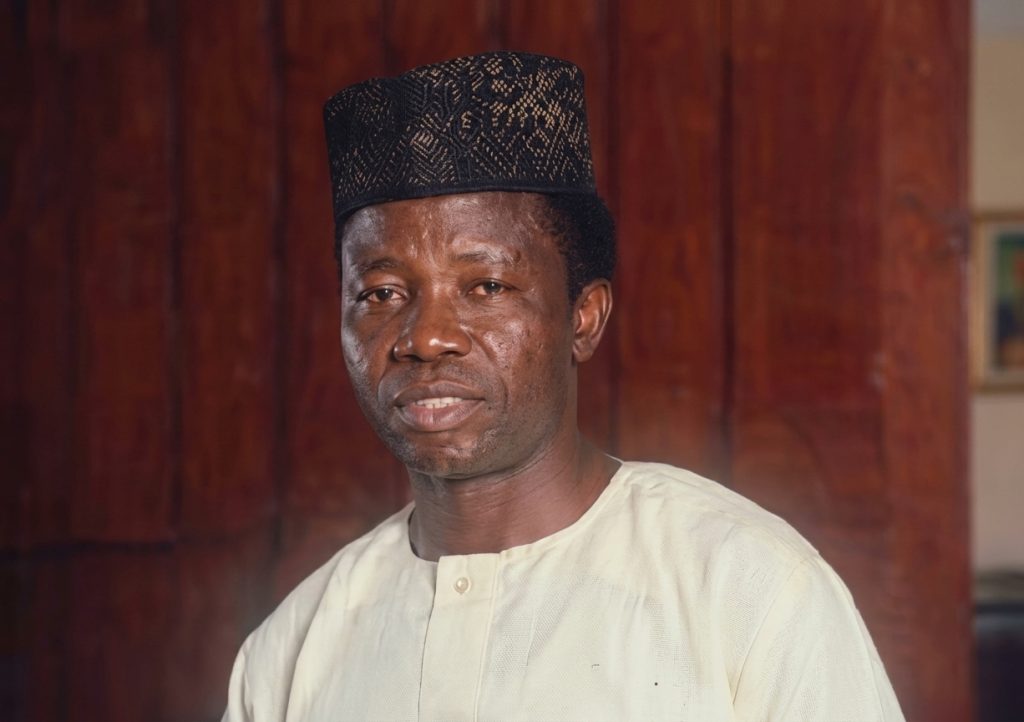
Political Party: Unity Party of Nigeria (UPN)
Era: Nigeria’s 2nd Republic
Distinction: The first democratically elected civilian Governor of Lagos State.
Political Ideology & Vision
- “Awoism in Action”: As a deeply loyal apostle of Chief Obafemi Awolowo, Jakande aggressively executed the UPN’s cardinal programs: free education, free healthcare, full employment, and integrated rural development.
- Egalitarian Pragmatism: He prioritized mass access over elite aesthetics. His policies were rigorously pro-poor, focusing on delivering maximum functional value to the largest number of Lagosians in the shortest possible time.
- Spartan Leadership: A seasoned journalist by profession, he ran an open-door policy, shunned the flamboyant perks of office (he lived in his personal house in Ilupeju and drove his private car), and ensured prudent management of state funds.
Landmark Achievements
1. Education: The Mass Literacy Drive
- Free Education: Abolished school fees entirely and provided free textbooks.
- Ending the Shift System: To accommodate an explosion in enrollment without waiting years to build luxury schools, he built rapid, functional classrooms (sometimes derisively called “Jakande schools” or “chicken pens” by critics, but they effectively abolished the morning/afternoon/evening shift system).
- Expansion: Built 22 colleges, 256 secondary schools, and over 800 primary schools.
- Tertiary Milestone: Established the Lagos State University (LASU) in 1983 to ensure children of the poor had access to university education.
2. Housing: The Low-Cost Revolution
- Constructed over 30,000 low-cost housing units to tackle the severe housing deficit.
- Funded these pro-poor estates by increasing tenement rates and land prices in affluent areas like Victoria Island and Lekki.
- Key Estates: Amuwo-Odofin, Oke-Afa (Isolo), Abesan, Iba, Iponri, Ipaja, Ikorodu, Epe, and Badagry.
3. Transportation & Infrastructure
- The Lagos Metroline: Initiated a visionary multi-billion-naira light rail project designed to permanently solve Lagos traffic congestion. (The foundation was laid, but it was unfortunately canceled by the subsequent military regime).
- Constructed major road networks across the state, including opening up the LASU-Iba corridor, and expanded municipal water works.
4. Healthcare & Media
- Built 20 general hospitals and health centers, including completing the Gbagada and Ikorodu General Hospitals.
- Established Lagos Television (LTV) and Radio Lagos to break the federal monopoly on broadcasting.
- Created 23 local government councils to bring governance closer to the grassroots.
Challenges & The 1983 Interruption
- Military Intervention: His tenure was abruptly cut short on December 31, 1983, by the military coup led by Major General Muhammadu Buhari, which terminated the 2nd Republic.
- Abandoned Visions: The military takeover led to the cancellation of his most ambitious project—the Lagos Metroline—at a great financial loss to the state.
- Political Prosecution: Like many politicians of that era, he was briefly imprisoned and tried for treason by the military tribunal before eventually being pardoned.
Enduring Legacy: The “Baba Kekere” Standard
(Replacing “Good thing during his tenure”)
Widely known by the affectionate moniker “Baba Kekere” (meaning “The Younger Awo” due to his alignment with Awolowo’s progressive ideals), Jakande remains the gold standard for public service in Nigeria. More than four decades after leaving office, his infrastructure still houses and educates millions. He is near-universally regarded by historians, political analysts, and citizens as the best governor Lagos State has ever had, proving that massive, people-oriented development is possible with disciplined, selfless leadership.