
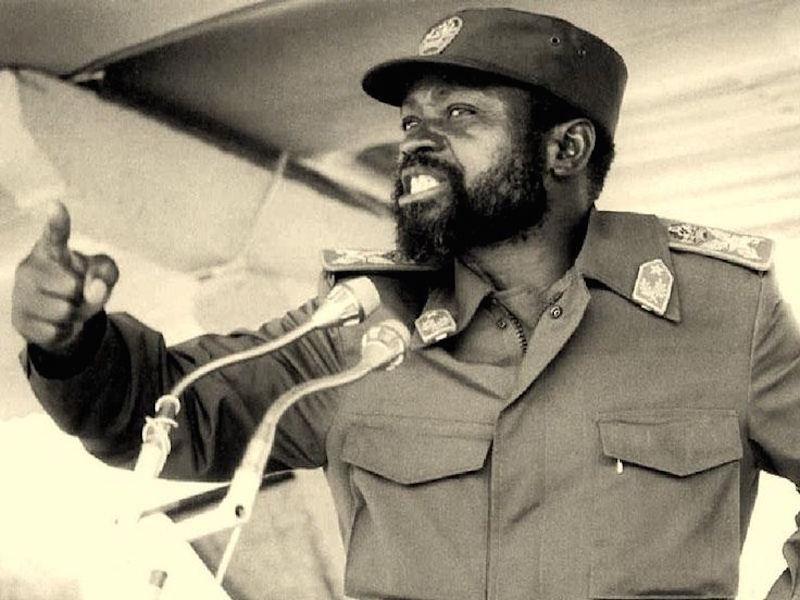
| Full Name | Samora Moisés Machel |
| Date of Birth | September 29, 1933 |
| Place of Birth | Madragoa (now Chilembene), Gaza Province, Portuguese Mozambique |
| Date of Death | October 19, 1986 |
| Age at Death | 53 |
| Nationality | Mozambican |
| Occupation | First President of Mozambique, Military Commander, Revolutionary Leader |
Samora Machel was a charismatic military commander and socialist revolutionary who led the Mozambican people to independence from Portuguese colonial rule in 1975, becoming the country’s first President. He is historically vital for his fierce anti-imperialist stance and his unwavering support for liberation movements across Southern Africa, including in Zimbabwe and South Africa. His death in a highly suspicious and controversial plane crash in 1986 robbed the continent of one of its most dynamic Pan-Africanist leaders and highlighted the extreme lengths to which the apartheid regime in South Africa would go to destabilize its neighbors.
Cause of Death
Samora Machel died on the night of October 19, 1986, when his presidential aircraft, a Soviet-built Tupolev Tu-134A-3, crashed into the Lebombo Mountains near the village of Mbuzini in South Africa, just meters from the borders of Mozambique and Swaziland (now Eswatini).
The official cause of death was blunt force trauma and severe injuries sustained during the high-speed impact of the aircraft. Thirty-four people died in the crash, including Machel, several Mozambican ministers, and international aides, while nine people survived.
The events leading to his death began earlier that day. Machel was returning to the Mozambican capital, Maputo, from a crucial regional summit in Mbala, Zambia. During the summit, leaders of the Frontline States had pressured Zaire’s dictator, Mobutu Sese Seko, to stop supporting the South African-backed UNITA rebels in Angola. As Machel’s flight neared Maputo on a dark and stormy night, the plane inexplicably deviated from its flight path by 37 degrees to the west, flying away from the Maputo runway and directly into South African airspace.
The aircraft descended below the minimum safe altitude, clipping a hillside at 21:11 local time. It broke apart and scattered debris across a large area of the rugged terrain.
The cause of the crash remains one of the greatest enduring mysteries and controversies of the Cold War era in Africa. The official South African inquiry, known as the Margo Commission, concluded that the crash was entirely due to pilot error by the Soviet flight crew, who supposedly misread their navigational instruments, ignored ground proximity warnings, and initiated a premature descent. The Soviet delegation and the Mozambican government vehemently rejected this finding.
The deeply disputed—but widely believed—claim is that the South African military intentionally lured the aircraft off course using a decoy VOR (VHF omnidirectional range) navigational beacon transmitting a false signal. Although the South African Truth and Reconciliation Commission (TRC) later found strong circumstantial evidence of a false beacon, no definitive, smoking-gun proof of apartheid government complicity has ever been legally established, leaving the crash a subject of fierce historical debate.
Biography: Why the Person Was Killed (or Why/How the Person Died)
Samora Machel’s death occurred at the climax of a brutally violent era in Southern Africa, an era defined by the struggle against white minority rule and the proxy conflicts of the Cold War. Born into a family of peasant farmers in the fertile Limpopo Valley, Machel grew up under the oppressive ‘Indigenato’ system of Portuguese colonialism, which forced his family to grow cotton at fixed, exploitative prices and seized their lands for white settlers. Machel initially trained as a nurse—one of the few professional avenues open to Black Mozambicans—but radicalized after witnessing the deep racial inequities in the colonial healthcare system.
In 1962, he joined the newly formed Front for the Liberation of Mozambique (FRELIMO) in neighboring Dar es Salaam, Tanzania. Recognizing his leadership potential, FRELIMO sent Machel to Algeria for military training. When the armed struggle against the Portuguese began in 1964, Machel quickly rose through the ranks due to his strategic brilliance and charisma. After the assassination of FRELIMO’s founder, Eduardo Mondlane, in 1969, Machel became the supreme commander of the guerrilla army. Under his leadership, FRELIMO waged a relentless and highly successful asymmetric war that, combined with the 1974 Carnation Revolution in Portugal, forced the collapse of the colonial empire.
Machel assumed the presidency of an independent Mozambique on June 25, 1975. He immediately implemented sweeping Marxist-Leninist reforms. He nationalized land, education, and healthcare, seeking to rapidly dismantle the deep socio-economic inequalities left by the Portuguese. However, the mass exodus of skilled Portuguese settlers devastated the economy.
It was Machel’s foreign policy that placed him in the crosshairs of the region’s most lethal powers. He firmly believed that Mozambique’s independence was incomplete as long as white minority regimes ruled neighboring Rhodesia (Zimbabwe) and South Africa. He courageously opened Mozambique’s borders to the Zimbabwe African National Liberation Army (ZANLA) and the African National Congress (ANC), providing them with military bases and logistical support.
This solidarity provoked devastating retaliation. The Rhodesian intelligence services created, trained, and armed a brutal proxy rebel group known as RENAMO (Mozambican National Resistance) to wage a war of terror inside Mozambique. After Rhodesia fell and became Zimbabwe in 1980, the apartheid regime in South Africa eagerly took over the sponsorship of RENAMO. Throughout the early 1980s, South Africa systematically destabilized Mozambique, destroying infrastructure, schools, and clinics, and causing a massive famine.
By 1984, the situation was so dire that Machel was forced to sign the Nkomati Accord with South African President P.W. Botha. It was a non-aggression pact: Mozambique agreed to expel ANC militants, and South Africa agreed to stop funding RENAMO. While Machel reluctantly kept his end of the bargain, the South African military blatantly violated the treaty, continuing to air-drop weapons to RENAMO.
In the months leading up to his death in October 1986, tensions between Mozambique and South Africa reached a boiling point. The South African military establishment viewed Machel as an intolerable communist threat and an obstacle to their regional hegemony. South African state media launched a vicious propaganda campaign against him, and defense officials publicly threatened him. Just days before the crash, a landmine exploded near the South African border, and Defense Minister Magnus Malan explicitly blamed Machel, warning of severe consequences. Consequently, when his plane crashed into South African territory shortly after these threats, the assumption of assassination was immediate and globally resonant.
Achievements
Samora Machel’s legacy is defined by his successful military liberation of his country and his unwavering commitment to Pan-African solidarity.
• Defeating the Portuguese Empire: As commander of FRELIMO’s armed forces, Machel masterminded the guerrilla campaign that effectively forced the Portuguese military to an unsustainable stalemate, leading to Mozambique’s independence in 1975.
• Pioneering Healthcare and Education Reforms: Upon taking power, Machel instantly nationalized private healthcare and education. Within his first few years, his government launched massive vaccination and literacy campaigns that drastically reduced infant mortality and improved educational access for millions of formerly marginalized Mozambicans.
• Crucial Support for Zimbabwean Independence: By enforcing United Nations sanctions against Rhodesia and allowing ZANLA guerrillas to operate from Mozambican soil, Machel accelerated the fall of Ian Smith’s white minority regime, directly contributing to the birth of an independent Zimbabwe in 1980.
• Championing Women’s Emancipation: Machel was a staunch advocate for gender equality, famously declaring that the liberation of women was a “fundamental necessity for the revolution.” He integrated women into the FRELIMO military and created the Organization of Mozambican Women (OMM) to advance their political and social rights.
Aftermath of the Death
The immediate aftermath of the crash was marked by chaos, suspicion, and global mourning. When news of Machel’s death broke, angry mobs attacked the South African and Malawian embassies in Maputo and Harare, firmly believing the apartheid regime had assassinated the beloved leader.
The political succession in Mozambique was handled smoothly to prevent a power vacuum. The central committee of FRELIMO elected Joaquim Chissano, the country’s foreign minister, to succeed Machel. Chissano continued the fight against RENAMO but eventually led the country toward a negotiated peace settlement and a multi-party democracy in 1992.
The investigation into the crash immediately became a heavily politicized international incident. Under international aviation rules, South Africa (as the state of occurrence) led the investigation. They established the Margo Commission, which included international aviation experts from the US and UK. In 1987, the Commission concluded that the plane was airworthy and the crash was exclusively caused by the Soviet crew’s failure to follow instrument flight rules, specifically ignoring a Ground Proximity Warning System (GPWS) alarm.
The Soviet Union and Mozambique strongly rejected the Margo report. The Soviet investigation alleged that a powerful, mobile VOR beacon had been placed in the Lebombo Mountains to override the Maputo airport signal, tricking the plane’s autopilot into making a fatal 37-degree turn. They argued the crew was flying correctly according to the tampered instruments.
A decade later, following the fall of apartheid, the South African Truth and Reconciliation Commission (TRC) launched a special investigation into the crash in 1998. The TRC heard testimonies from former military intelligence officers and locals who claimed to have seen heavily armed military vehicles and a mobile beacon near the crash site on the night of October 19. While the TRC concluded that the evidence of a decoy beacon was highly credible, it lacked the final documentary proof to definitively rule it a state-sponsored assassination. Consequently, formal justice or accountability was never achieved.
Critical Stories People Need to Know About the Death
1. The Bizarre Behavior of South African Police
Survivors of the crash reported a chilling scene. When the South African police arrived at the wreckage in Mbuzini, they did not immediately attempt to rescue the bleeding and dying passengers. Instead, survivors testified that officers rummaged through the wreckage with flashlights, aggressively confiscating diplomatic bags, state documents, and Machel’s personal briefcases. Medical help was allegedly delayed for hours while the intelligence gathering took priority.
2. The 37-Degree Turn
The entire mystery hinges on a sudden, unexplained 37-degree right turn the aircraft made while approaching Maputo. The flight data recorder confirmed the autopilot initiated this turn based on a VOR navigational signal. Maputo airport officials maintained their VOR beacon was functioning correctly, leading investigators to suspect that a stronger, false signal on the same frequency was deliberately broadcast from the South African mountains to hijack the plane’s navigation system.
3. The Missing Soviet Flight Engineer
Vladimir Novoselov, the flight engineer, was one of the few survivors. He consistently maintained that the plane was functioning perfectly and that they had been led astray by a false signal. His testimonies were highly restricted by the Soviet government upon his return to Moscow, fueling conspiracy theories, but he remained adamant until his death that the apartheid government had engineered the crash.
4. Graça Machel’s Lifelong Quest
Machel’s widow, Graça Machel (who served as his Minister of Education), never accepted the official South African narrative. She dedicated decades to pushing for independent investigations, publicly asserting her husband was murdered. Graça Machel later married Nelson Mandela in 1998, remarkably becoming the first woman in history to be the First Lady of two different nations. Mandela fully supported her belief that Samora was assassinated.
5. The Failure of the Nkomati Accord
The crash highlighted the treacherous nature of the apartheid government. In 1984, Machel had signed the Nkomati non-aggression pact with South Africa. However, diaries captured from RENAMO bases shortly before Machel’s death proved the South African Defence Force (SADF) had continually violated the treaty, providing heavy weaponry to the rebels. This deceit provided strong motive for assassination, as Machel was exposing South Africa’s international treaty violations.
6. The TRC’s Unfinished Business
In 1998, the South African TRC conducted an inquiry into the crash. They discovered that former members of the Military Intelligence and the shadowy Civil Cooperation Bureau (CCB) were highly active in the area on the night of the crash. The TRC report strongly suggested the presence of a decoy beacon but concluded that a full, international judicial inquiry was required to prove it definitively—an inquiry that has never materialized.
7. The VOR Beacon “Camp”
During the TRC hearings, several witnesses from the South African side of the border testified to seeing a military encampment with large antennae erected on the Lebombo Mountains precisely in the days leading up to the crash. Following the night of October 19, the encampment rapidly vanished, leaving behind only vehicle tracks and empty ration tins.
8. The Legacy of the Tupolev Tu-134
The aircraft itself was scrutinized. The Margo Commission blamed the Soviet equipment as outdated and the crew as arrogant. However, aviation experts noted that the Tu-134 was a robust aircraft and the crew was highly experienced, having flown into Maputo dozens of times. The cockpit voice recorder captured the crew expressing profound confusion over the navigational readings just moments before impact, supporting the theory that external manipulation was occurring.
References
• Encyclopaedia Britannica. “Samora Machel | President of Mozambique, FRELIMO Leader.” Britannica Academic.
• Truth and Reconciliation Commission of South Africa Report. Volume 2, Chapter 6: Special Investigation into the death of President Samora Machel. 1998.
• Christie, Iain. Machel of Mozambique. Zimbabwe Publishing House, 1988.
• Isaacman, Allen, and Barbara Isaacman. Mozambique: From Colonialism to Revolution, 1900-1982. Westview Press, 1983.
• BBC News. “1986: Mozambican president dies in plane crash.” On This Day, October 19.
• Fauvet, Paul. “The Machel plane crash: 20 years later.” Mail & Guardian, October 2006.
• Margo, C.S. Report of the Board of Inquiry into the Accident to Tupolev 134A-3 Aircraft C9-CAA on 19th October 1986. South African Department of Transport, 1987.